
How Cooperatives are Controlled
The term governance is broadly defined as how an organization or region is controlled and how decisions are reached. Cooperatives have a unique governance structure that reflects the fact that they are owned and controlled by their members. While the term governance is most often associated with the board of directors, effective cooperative governance depends on four groups: members, the board of directors, management, and employees.
Click on any group below to see more information about its role in governance..
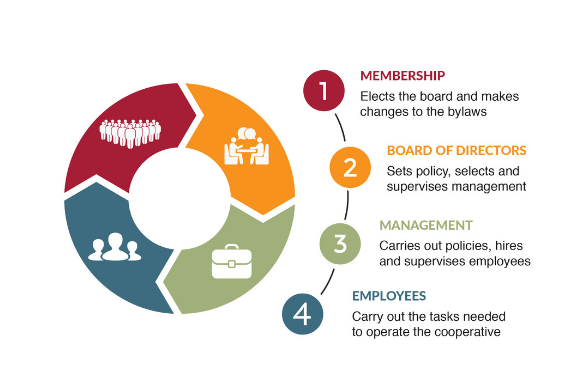
Roles and Responsibilities
Members
Members own and control the cooperative, which is organized and operated for their benefit. Members exercise control of the cooperative by voting to elect a board of directors to act on their behalf. In a small percentage of cooperatives, all members serve on the board. This is called direct democracy. Members also vote on changes to the articles of incorporation and bylaws, and on cooperative mergers or dissolution. In Wisconsin, each member typically receives one vote. Members must understand the issues facing their cooperative in order to make sounds decisions, so member communication and education programs are a good investment.
Board of Directors
In a cooperative, the board of directors is elected by and from the membership. The board establishes long-term business strategies that balance the needs of the membership with the cooperative’s financial sustainability. They review and evaluate all financial reports, assess the capital needs of the cooperative, and determine patronage refund allocations. They establish operating policies and are responsible for hiring and evaluating the general manager/CEO.
Management
A cooperative’s management is hired by the board to help inform and carry out its strategic objectives. The general manager/CEO oversees the day-to-day operations of the cooperative and reports on the co-op’s financial and operational performance to the board. The general manager/CEO makes recommendations for long-range planning and develops the budget for board approval.
Employees
A co-op’s employees carry out cooperative operations that provide the goods and services needed by the members. Employee understanding of cooperative principles and objectives can be an important part of positive member relations. In the case of worker-owned cooperatives, management and employees may also be members.
Resources
General Governance
Cooperative Governance Research Initiative Reports
CGRI Governance Data Dashboard
Cooperative Essentials: What They Are and the Role of Members, Directors, Managers, and Employees. USDA Cooperative Information Report 11, 2014.
The Governance of Large Co-operative Businesses: A research study. Johnston Birchall. 2014.
Humanistic Governance in Democratic Organizations: The Cooperative Difference. Sonja Novković, Karen Miner, Cian McMahon, 2023.
Co-operative Governance Fit to Build Resilience in the Face of Complexity. International Cooperative Alliance. 2015.
Board of Directors
The Circle of Responsibilities for Co-op Boards. USDA Cooperative Information Report 61, 2014.
Sample Policies for Cooperatives, USDA Cooperative Information Report 39, 1993.
Director Onboarding Guide. UW Center for Cooperatives, 2021.
Webinar: Onboarding with Purpose: Systems and Strategies for Successfully Integrating New Directors. UW Center for Cooperatives, 2021.
Webinar: Elements of Board Oversight. UW Center for Cooperatives, 2020.
Webinar: Ensuring Governance Continuity. UW Center for Cooperatives, 2020
Webinar: Roles and Responsibilities of Co-op Directors. UW Center for Cooperatives, 2020.
Webinar: Cooperative Finance 101. UW Center for Cooperatives, 2020.
Committees
Frequently Used Committees in Cooperatives. UW Center for Cooperatives, 2025
Agile and Efficient: Board Committees and Committee Structures that Work. Cooperative Grocer, January-February 2013.
Board Committee Charter Template (Link to word doc)