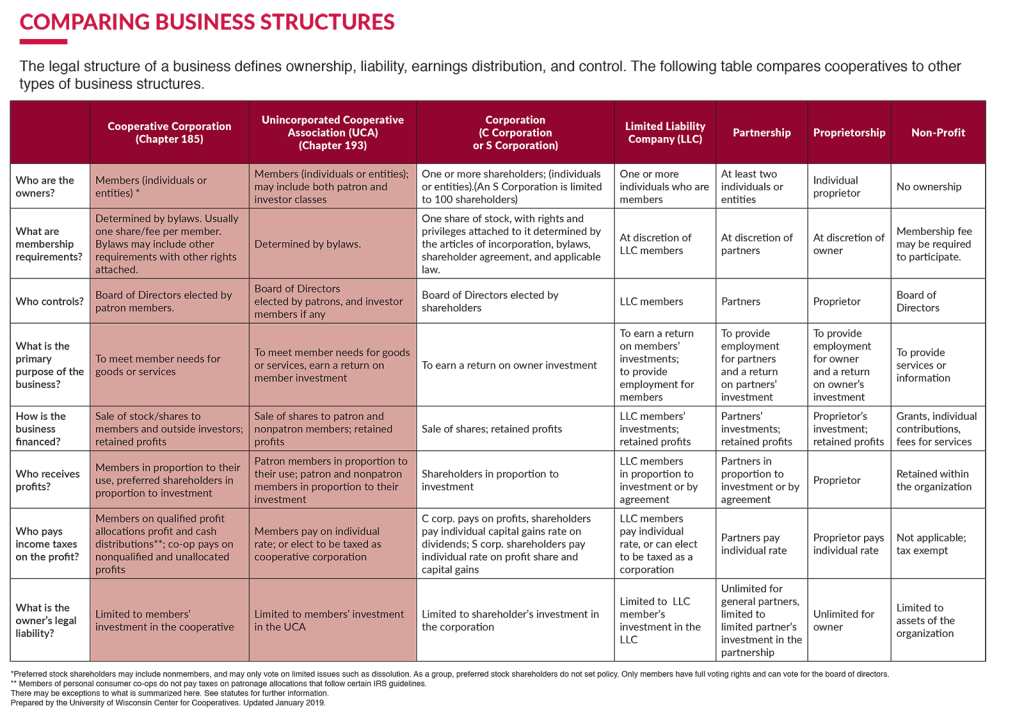
Every business has rules that determine who owns it, who makes decisions, and how profits are shared. Like other businesses, cooperatives are legally incorporated under state law, but the specific rules for cooperatives can vary from state to state.
In most businesses, ownership and control are based on how much money someone invests. Profits are usually shared according to the size of each owner’s investment.
Cooperatives work differently. They are owned and democratically controlled by their members. Members provide the cooperative’s investment funds and typically have an equal say in important decisions. Any profits are shared based on how much members use the cooperative’s services, rather than how much money they invested.
In some states, cooperatives are set up under nonprofit laws because their main purpose is to provide services to members at cost. However, unlike traditional nonprofits, cooperative members are owners. They have rights such as voting, sharing in profits, and receiving a share of assets if the cooperative is sold or closed.
Click on a business type below to learn about its key features and compare it with other business structures.
Cooperative Corporation (Chapter 185)
Who owns it?
Members (individuals or entities)
What are the membership requirements?
Determined by bylaws. Usually one share/fee per member. Bylaws my include other requirements with other rights attached.
Who controls it?
A board of directors elected by patron members.
What is the primary purpose of the business?
To meet members’ needs for goods or services
How is the business financed?
Sale of stock/shares to members and outside investors; retained profits.
Who receives profits?
Members in proportion to their use, preferred shareholders in proportion to investment.
Who pays the income taxes on the profit?
Members on qualified profit allocations profit and cash distributions**; co-op pays on non qualified and unallocated profits.
What is the owner’s legal liability?
Limited to the member’s investment in the cooperative
Unincorporated Cooperative Association (UCA) (Chapter 193)
Who owns it?
Members (individuals or entities); may include both patron and investor classes
What are the membership requirements?
Determined by bylaws.
Who controls it?
A board of directors elected by patron members, and investor members, if any.
What is the primary purpose of the business?
To meet members’ needs for goods or services, earn a return on member investment.
How is the business financed?
Sale of shares to patron and non-patron members; retained profits.
Who receives profits?
Members in proportion to their use, patron and non-patron member in proportion to their investment.
Who pays the income taxes on the profit?
Members pay on individual rate; or elect to be taxed as cooperative corporation.
What is the owner’s legal liability?
Limited to the member’s investment in the UCA.
Corporation (C Corportation or S Corporation)
Who owns it?
One or more shareholders; (individuals or entities). (An S Corporation is limited to 100 shareholders).
What are the membership requirements?
One share of stock, with rights and privileges attached to it determined by the articles of incorporation, bylaws, shareholder agreement, and applicable law.
Who controls it?
A board of directors elected by shareholders.
What is the primary purpose of the business?
To earn a return on owner investment.
How is the business financed?
Sale of shares; retained profits.
Who receives profits?
Shareholders in proportion to their investment.
Who pays the income taxes on the profit?
C Corp. pays on profits, shareholders pay individual capital gains rate on dividends; S. Corp. shareholders pay individual rate on profit share and capital gains.
What is the owner’s legal liability?
Limited to the shareholder’s investment in the corporation.
Limited Liability Company (LLC)
Who owns it?
One or more individuals who are members.
What are the membership requirements?
At the discretion of LLC members.
Who controls it?
LLC members.
What is the primary purpose of the business?
To earn a return on member’s investments; to provide employment for members.
How is the business financed?
LLC members’ investments; retained profits.
Who receives profits?
LLC members in proportion to their investment or by agreement.
Who pays the income taxes on the profit?
LLC members pay individual rate, or can elect to be taxed as a corporation.
What is the owner’s legal liability?
Limited to the LLC member’s investment in the LLC.
Partnership
Who owns it?
At least two individuals or entities.
What are the membership requirements?
At the discretion of partners.
Who controls it?
Partners
What is the primary purpose of the business?
To provide employment for partners and a return on partner’s investment.
How is the business financed?
Partners’ investments; retained profits.
Who receives profits?
Partners in proportion to their investment or by agreement.
Who pays the income taxes on the profit?
Partners pay individual rate.
What is the owner’s legal liability?
Unlimited for general partners, limited to limited partner’s investments in the partnership.
Proprietorship
Who owns it?
Individual proprietor.
What are the membership requirements?
At the discretion of owner.
Who controls it?
Proprietor
What is the primary purpose of the business?
To provide employment for owner and a return on owner’s investment.
How is the business financed?
Proprietors’ investments; retained profits.
Who receives profits?
Proprietor
Who pays the income taxes on the profit?
Proprietor pay individual rate.
What is the owner’s legal liability?
Unlimited for owner.
Non-Profit
Who owns it?
No ownership
What are the membership requirements?
Membership fee may be required to participate.
Who controls it?
Board of Directors
What is the primary purpose of the business?
To provide services or information.
How is the business financed?
Grants, individual contributions, fees for services.
Who receives profits?
Retained within the organization.
Who pays the income taxes on the profit?
Not applicable; tax exempt.
What is the owner’s legal liability?
Limited to the assets of the organization.
* Preferred stock shareholders may include nonmembers, and may only vote on limited issues such as dissolution. As a group, preferred stock shareholders do not set policy. Only members have full voting rights and can vote for the board of directors
** Members of personal consumer co-ops do not pay taxes on patronage allocations that follow a certain IRS guidelines.
There may be exemptions to what is summarized here, see statutes for further information.